Your SaaS website is not a brochure. It is not just a place to park your logo and a “Sign Up” button. Done right, it is your single highest-leverage growth asset, working around the clock to educate prospects, build trust, and convert visitors into paying customers.
And yet, so many SaaS companies treat their website as an afterthought. They hire a generalist agency, get something that looks fine, and wonder why their trial signups aren’t growing, their bounce rate is sky-high, and their best competitors seem to be pulling away.
Here’s the reality: a SaaS website built without deep product understanding, conversion-focused SaaS design, and growth-stage thinking will cost you far more in lost revenue than it saves in agency fees.
This guide is for SaaS founders, CEOs, CTOs, marketing leaders, and product managers who are ready to make a smart, informed decision about their next web design investment. We’ll walk you through why specialized UX matters, what best Saas web design agencies actually do, what it costs, and most importantly, how to pick the best Saas web design agency for your specific stage and goals.
Why SaaS Companies Need Specialized UX not General Web Design
There is a meaningful difference between a web design agency that can build you a website and one that knows how to design a website that grows a SaaS business. The gap between them is wider than most founders expect.
General agencies don't speak your language
Most web design firms are experts at creating beautiful digital experiences. But unless they work exclusively or primarily with SaaS companies, they may not understand your buyer journey, your product-led vs. sales-led dynamics, or the role your marketing site plays in the broader acquisition funnel.
A SaaS UX design agency understands things like: the critical difference between a trial signup and a demo request, how to design for multiple buyer personas simultaneously, why your pricing page is your most important conversion page, and how interactive product demos can replace lengthy sales calls.
SaaS websites have unique UX requirements
Your website needs to accomplish something difficult: explain a complex software product clearly, build credibility quickly, address objections preemptively, and guide visitors toward a specific action all without a salesperson in the room.
This requires specialized skills in information architecture, UX writing, conversion rate optimization (CRO), and an understanding of how B2B buyers actually research and evaluate software. A generalist agency may get the aesthetics right while completely missing the conversion mechanics.
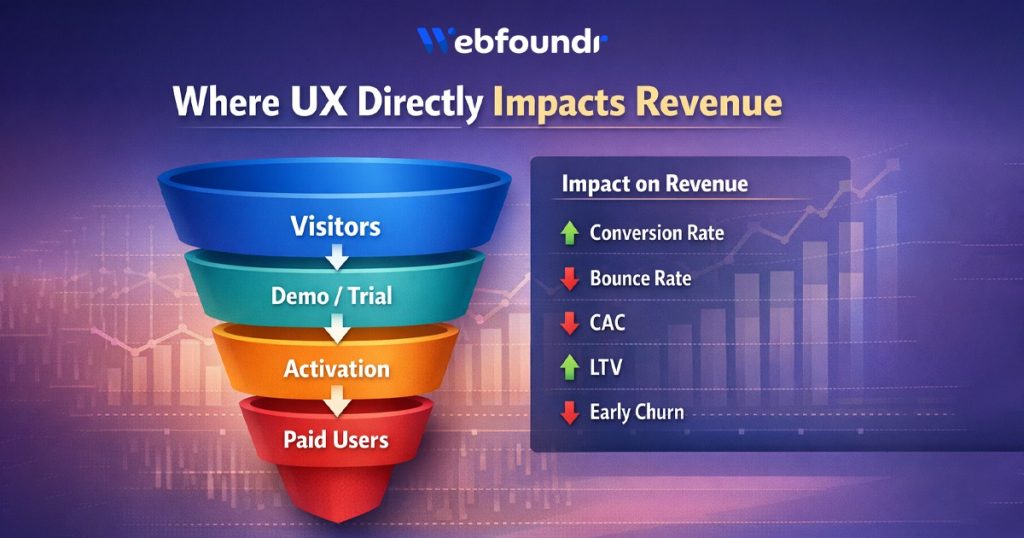
How Specialized UX Directly Impacts SaaS Growth Metrics
This is where the rubber meets the road. The right SaaS UX design doesn’t just make your site look better it measurably moves the metrics that matter to your business.
Trial & Demo Conversion Rate:
A strategically designed website with clear messaging, social proof, and frictionless CTAs can double or triple your conversion rate from anonymous visitor to qualified lead.
Time-to-Understand:
Great UX reduces the time it takes a visitor to understand what you do and why it matters. Faster comprehension = more sign-ups.
Churn from Misalignment:
When your website clearly sets expectations about your product, you attract better-fit customers leading to lower early churn.
SEO-Driven Pipeline:
Properly structured SaaS websites, built with both search intent and user experience in mind, compound their value over time through organic traffic.
Sales Cycle Length:
A website that does the education and objection-handling work means your sales team spends less time on basics and more time closing.
Pro Tip:
A well-executed SaaS website redesign for growth is not a cost it is a revenue investment with a measurable return. Top SaaS companies treat their marketing site as a product in its own right, with dedicated resources, ongoing iteration, and clear KPIs.
SaaS Website Design vs SaaS Product Design
One question that comes up constantly: “Do I need a web design agency or a product design agency?” The answer depends on what you’re trying to solve.
SaaS Website Design
This covers your marketing site the public-facing pages that live before the login wall. Homepage, pricing, about, features, blog, case studies, landing pages. The goal is to attract, educate, and convert prospects.
SaaS Product Design (UI/UX)
This covers the in-app experience the dashboards, workflows, and interfaces your paying customers interact with daily. The goal is activation, retention, and expansion.
Both matter deeply, but they require different skill sets and methodologies. Some agencies specialize in one; others offer both as part of a broader SaaS UI UX design engagement. If your biggest challenge is acquiring and converting customers, start with your marketing site. If churn and activation are the issues, focus on product UX.
The good news is that the best SaaS UX design agencies understand the full customer journey and can help you prioritize where to invest first.
What Services Does a True SaaS Web Design Agency Provide?
Not all agencies that claim to work with SaaS companies are created equal. Here is what a genuinely specialized web design agency for SaaS should offer:
1. SaaS-Focused Discovery & Strategy
Before a single pixel is designed, a great agency digs into your ICP (ideal customer profile), competitive landscape, messaging, conversion goals, and growth stage. This is not optional it is the foundation everything else is built on.
2. UX Research & User Journey Mapping
Understanding how your buyers actually think, search, and make decisions shapes every design choice. Expect interviews, heatmap analysis, UX for SaaS startups frameworks, and jobs-to-be-done analysis.
3. Conversion-Focused Design
Every page, layout, and CTA should be designed with a conversion goal in mind. This means strategic placement of social proof, benefit-led copywriting, clear visual hierarchy, and deliberate funnel design.
4. High-Performance Development
The best design and development agencies for SaaS build sites that are not just beautiful they are fast, accessible, and technically sound. Core Web Vitals, page speed, and mobile responsiveness are non-negotiable.
5. SEO Architecture
A SEO agency for SaaS builds your site structure with search intent in mind from day one. This means proper topic clustering, internal linking strategy, schema markup, and content architecture that compounds over time.
6. CRO & Ongoing Optimization
The best relationships don’t end at launch. A SaaS CRO agency will set up A/B testing, analyze user behavior, and continuously improve your site’s conversion performance post-launch.
7. Messaging & Copywriting
Design and copy are inseparable. Great agencies either have in-house UX writers or strong partnerships with SaaS copywriters who can translate technical features into compelling customer benefits.
How Much Does a SaaS UI/UX Design Agency Cost in the USA?
Let’s talk numbers. Pricing varies widely based on the agency’s reputation, team size, engagement scope, and your specific needs. Here’s a realistic breakdown of average cost for a complete SaaS website redesign project in the U.S.:
Freelancers / Solo Designers:
$3,000 – $15,000. Best for early-stage startups with limited budgets. Expect limited strategy and no ongoing support.
Small Boutique SaaS Agencies:
$15,000 – $50,000. The sweet spot for most Series A and below startups. You get a dedicated team, strategy, and quality execution.
Mid-Size Specialized Agencies:
$50,000 – $150,000. Ideal for growth-stage companies preparing for a major scale push or post-Series B reinvention.
Enterprise / Premium Agencies:
$150,000+. Typically reserved for well-funded scale-ups or enterprise SaaS companies with complex multi-audience sites.
Important Context:
A SaaS website redesign that improves your conversion rate from 2% to 4% on a site generating $1M in pipeline will pay for itself many times over. Focus on ROI, not just sticker price.
When evaluating pricing, also ask about SaaS website optimization retainers post-launch. Ongoing CRO, SEO content, and iterative design can deliver compounding returns that a one-time project simply cannot.
In-House vs Specialized SaaS Agency: Which Is Better?
This is one of the most common debates inside SaaS companies. Here’s how to think through it honestly.
The Case for In-House
An in-house team has deep product context, can move quickly on small iterations, and is always available. If you’re at the stage where your site needs constant, rapid updates and you have the volume of work to justify it, an in-house designer makes sense.
The Case for a Specialized Agency
A SaaS web design agency brings something your in-house team rarely has: outside perspective plus pattern recognition from dozens of similar projects. They’ve seen what works, what fails, and why. They’ve designed pricing pages, homepage hero sections, and onboarding flows for companies at your exact stage and learned from each one.
Specialized agencies also bring a full team: strategists, UX designers, developers, copywriters, and SEO specialists. Hiring all of those in-house for a project-based initiative rarely makes financial sense.
The Hybrid Approach
Many top SaaS web design agencies in the United States are happy to work alongside your in-house team. They handle the strategic redesign and major lift; your team owns ongoing content and minor updates. This is often the most effective model for growth-stage SaaS companies.
How to Choose the Best SaaS Web Design Agency
With so many options from affordable SaaS web design agencies to premium firms narrowing down your shortlist requires a structured approach. Here’s what actually matters:
1. SaaS-Specific Portfolio
The single most important signal. Look for agencies with a portfolio of SaaS clients not just pretty tech-adjacent work. Do their case studies show business outcomes like increased conversions, reduced bounce rate, pipeline growth, or just visual deliverables?
2. Strategic Process, Not Just Visual Execution
Ask how they start an engagement. Do they begin with discovery, research, and strategy or do they jump straight to wireframes? A great B2B SaaS web design agency starts with deep understanding, not a mood board.
3. Understanding of SaaS Business Models
Your agency should understand PLG vs. SLG, ARR and CAC dynamics, and how your marketing site fits into your overall SaaS growth strategy. If they don’t know what MRR is, that’s a red flag.
4. Cross-Functional Capabilities
The best results come from agencies that integrate design, development, copy, and SEO. Ask specifically about web design and marketing company capabilities you don’t want to stitch together three vendors for one project.
5. Post-Launch Support
Launch day is not the finish line. Ask about ongoing SaaS website optimization services, retainer options, and how they measure post-launch success.
6. Communication & Collaboration Style
This is underrated. You’ll be working closely with this team for months. Do they communicate clearly? Are they responsive? Do they push back constructively when needed? Reference checks matter here.
Key Questions to Ask Before Hiring a SaaS Web Design Agency
Before signing any contract, make sure you can get satisfying answers to these questions. They’ll reveal a lot about whether the agency is the right fit for how to select a web design agency for a B2B SaaS company.
“Can you show us 3–5 SaaS website redesigns you’ve done and what measurable outcomes resulted?”
“What does your discovery process look like, and how long does it typically take?”
“How do you approach messaging and positioning for a SaaS product do you have in-house copywriters?”
“How do you design for multiple ICPs or buyer personas within a single site?”
“What does your handoff process look like, and what does post-launch support include?”
“How do you build SEO architecture into the site structure from day one?”
“What CMS or tech stack do you recommend for SaaS marketing sites, and why?”
“Do you offer CRO retainers or ongoing A/B testing services after launch?”
“What are the biggest mistakes SaaS companies make with their websites and how do you help avoid them?”
That last question is particularly revealing. A great agency will have strong, specific opinions based on real experience. A generalist agency will give you a vague, hedged answer.
Conclusion: Your Website Is Your SaaS Growth Lever
If you’ve read this far, you already understand something that many SaaS founders miss until it’s too late: your website is not a static asset it’s a dynamic growth lever
The best SaaS web design agencies don’t just build beautiful sites. They build sites that align with your growth stage, convert your ideal customers, rank in search, and compound in value over time. That is a fundamentally different proposition from hiring a general web design firm.
When you’re evaluating your options, ask the hard questions. Dig into portfolios and case studies. Look for agencies that speak your language conversion rates, pipeline, ARR, ICP, PLG, not just pixels and color palettes.
Whether you’re looking for a UX agency for SaaS startups to help you launch your first marketing site, or a responsive web design agency to refresh a site that’s no longer performing, the right partner is out there and choosing them well may be one of the highest-ROI decisions you make this year.
Ready to find the right SaaS web design agency for your growth stage?
Whether you’re an early-stage startup refining your positioning, or a scaling SaaS company preparing for your next funding round, your website should work as hard as your product does. At Webfoundr, we specialize in turning complex SaaS products into growth engines.
FAQ
1. What makes a SaaS web design agency different from a general web design agency?
A specialized SaaS web design agency understands the full SaaS go-to-market motion from how B2B buyers discover and evaluate software, to how your marketing site fits into a product-led or sales-led funnel. They bring expertise in conversion rate optimization (CRO), SaaS messaging frameworks, pricing page design, demo and trial flow optimization, and SEO architecture built for compounding organic growth. A general agency focuses primarily on aesthetics and basic functionality.
2. How much does a SaaS website redesign cost?
The average cost for a complete SaaS website redesign project in the U.S. typically ranges from:
- $20,000–$40,000 for early-stage startups
- $40,000–$80,000 for growth-stage SaaS
- $80,000+ for enterprise-level companies
The final cost depends on scope, CRO integration, messaging strategy, development complexity, and SEO alignment. A strong SaaS UX design agency treats the website as revenue infrastructure, not a cosmetic update.
3. How long does a SaaS website redesign take?
Most SaaS website redesign projects take between 8 and 20 weeks from kickoff to launch, depending on the size and complexity of your site, the depth of strategy and discovery work involved, and how quickly your team can provide feedback and approvals. Be wary of any agency that promises a full redesign in under 6 weeks, speed without strategy rarely delivers lasting results.
4. How do I know if my Saas website actually needs a redesign?
Your website is overdue for a redesign if you’re experiencing any of these warning signs:
- High bounce rate, which means visitors land and leave without exploring further, signaling a messaging or UX problem.
- Low trial or demo conversion rate meaning qualified traffic isn’t converting at the rate your competitors’ sites achieve.
- Your product has evolved but your website still reflects a version of your product from 18 months ago.
- Sales reps are doing the website’s job, spending call time explaining basics that a well-designed site should communicate instantly.
- Your organic traffic is flat or declining, a signal that your site’s SEO architecture needs a strategic overhaul.
If two or more of these are true, the cost of not redesigning is almost certainly higher than the investment required to fix it.
5. Should we hire an in-house team or a specialized SaaS web design agency?
For most SaaS companies, a specialized agency offers better ROI than a fully in-house team. Here’s why: a single in-house designer can’t replicate the cross-functional expertise strategy, UX, development, copywriting and SEO that a good web design agency brings as a unit. You’d need 4–6 hires to match that, which rarely makes sense for a project-based initiative.